
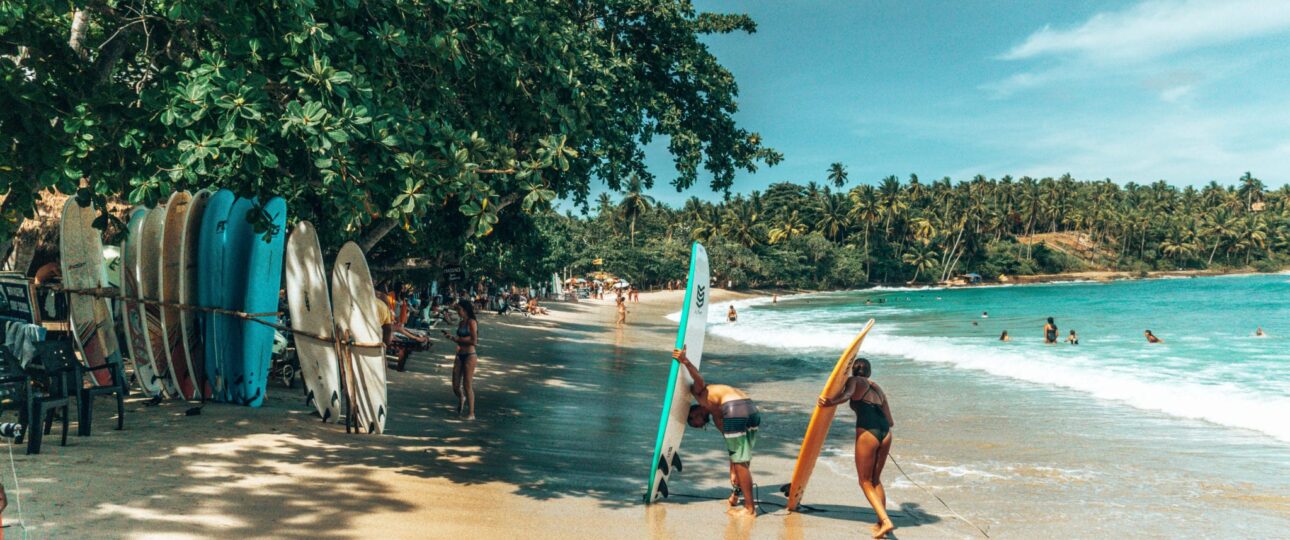
Here’s a strange but true fact that explains why visit Sri Lanka keeps coming up in every serious island travel conversation, you can wake up to waves on a southern beach, be walking through dense rainforest by mid-morning, spot a wild leopard by early afternoon, sip Ceylon tea in cool mountain air an hour later, and watch the sun set over a 5th century rock fortress, all in a single day, without ever getting on a plane. That kind of range simply isn’t possible on most islands, where one ecosystem is the whole trip. It’s the clearest, most physical answer to why visit Sri Lanka instead of somewhere that only does one thing well, and once you see the numbers behind it, the reason becomes obvious.
1. The Geography Trick No Other Island Pulls Off
Sri Lanka is roughly 432 km from north to south and 224 km at its widest point, small enough that a single day’s drive can cross from coastal lowlands into central highlands that climb past 2,500 meters. Most islands are geologically simple: flat coral atolls, or a single volcanic ridge repeating the same view for miles. Sri Lanka is neither. It has three distinct climate zones, a wet southwest soaked by two monsoons, a dry north and east baked by long dry seasons, and a cool hill country in between where nighttime temperatures can drop into the mid-teens Celsius, all packed into an island roughly the size of Ireland.
That compression is the whole story. On a two week trip, most travelers realistically string together four or five completely different environments, ancient cities, rainforest, dry-zone safari plains, tea covered mountains, and coastline, without a single domestic flight. Compare that to the Maldives, where every inter-atoll transfer means another seaplane or speedboat, or the Greek islands, where hopping from one Cycladic island to the next eats a full day of ferry schedules. In Sri Lanka, the ecosystems are close enough that the transfer between them becomes part of the itinerary, not a tax on it.
2. A Biodiversity Hotspot the Size of a Small Country
Sri Lanka is officially recognized as one of the world’s biodiversity hotspots, and the numbers are unusual for an island its size. Roughly 27% of its more than 3,200 flowering plant species and 22% of its mammals exist nowhere else on Earth, an endemism rate far higher than India’s (around 7%) or Europe’s (under 1%). The island supports 453 recorded bird species, of which around 33 to 34 are found only in Sri Lanka.
The Sinharaja Forest Reserve, the country’s last viable stretch of primary lowland rainforest, concentrates that diversity into a single UNESCO-protected pocket. More than 60% of its trees are endemic, and 19 of Sri Lanka’s roughly 20 to 21 truly endemic bird species, about 95%, live within its boundaries. Bird walks here regularly turn up mixed feeding flocks of 30 to 50 birds moving through the canopy together, led by the orange billed babbler and greater racket tailed drongo, with rarities like the red-faced malkoha and Sri Lanka blue magpie mixed in.
For travelers, this isn’t just a statistic, it changes what a single morning in the jungle can show you. A guided walk through Sinharaja can turn up birds, frogs, and plants that literally cannot be seen anywhere else on the planet, something no beach and resort island can offer no matter how polished its coastline is.
3. Wildlife Density That Rivals Africa, Minus the Flight Time
Sri Lanka is one of the very few island nations where a beach holiday and a genuine safari sit an hour or two apart. Yala National Park has one of the highest leopard densities recorded anywhere on Earth, close to one leopard per square kilometer in its most concentrated blocks. Unlike African leopards, which stay nocturnal to avoid lions, Sri Lanka’s leopards sit at the top of the food chain with no natural competitor, so they hunt and move during daylight, making sightings far more likely.
Further north, Minneriya and Kaudulla national parks host what’s known as The Gathering, a dry-season congregation of wild Asian elephants around a shrinking reservoir that can bring together more than 300 animals in a single herd, the largest wild elephant gathering anywhere in the world. Wilpattu, the island’s largest national park at over 1,300 square kilometers, adds sand-rimmed natural lakes called villus that draw sloth bears, crocodiles, and prolific water birds.
Then the Ocean Adds the Planet’s Largest Animal
Off the southern town of Mirissa, roughly a two hour drive from Colombo, boats head out most mornings between November and April chasing a different kind of wildlife entirely: blue whales. These are the largest animals to have ever lived, some individuals stretching past 30 meters and weighing well over 150 tonnes, with a heart reportedly the size of a small car. Sri Lanka’s continental shelf drops steeply just offshore, pulling deep-water whales unusually close to land, which is why sighting rates here run higher than almost anywhere else on the planet. Trincomalee on the east coast picks up the season from May to September, so between the two coasts, blue whale watching is realistically available most of the year.
4. The Spice Behind the Storym – Ceylon Cinnamon
Long before wellness tourism or eco-lodges, Sri Lanka’s ecosystems were already shaping global trade. The island produces roughly 80 to 90% of the world’s true cinnamon, Cinnamomum verum, sometimes called Ceylon cinnamon, and is home to seven additional wild cinnamon species found nowhere else, including varieties restricted to specific microclimates in the upcountry rainforests. Spice gardens across the south and west coasts still grow, peel, and dry cinnamon using techniques barely changed in centuries, alongside cardamom, pepper, nutmeg, and cloves grown in the same small plots.
It’s a small detail, but it captures something bigger, Sri Lanka’s landscapes aren’t just scenic backdrops, they’re the same ecosystems that shaped its cuisine, its centuries of trade history, and its identity long before the word “tourism” existed.
What a Single Day Can Actually Look Like
- Early morning (6:00-9:00 am): a beach sunrise near Mirissa or Weligama, followed by a boat trip with a strong chance of spotting dolphins or, in season, blue and sperm whales just offshore.
- Mid-morning (9:30-11:30 am): a guided rainforest or mangrove walk through lowland jungle thick with endemic birdlife, mixed feeding flocks, and the occasional monitor lizard or purple faced langur overhead.
- Early afternoon (12:00-3:00 pm): a jeep safari through dry zone scrub and grassland, watching for leopards, elephants, and peacocks before the heat peaks.
- Late afternoon (3:30-5:30 pm): a climb into hill country, where the air cools by several degrees and tea plantations take over the hillsides in neat, terraced rows.
- Evening: dinner near a centuries-old fort or ancient city, with the day’s four or five ecosystems still visible in the changing light outside.
Try building that same day on a single atoll island destination and the plan collapses immediately, there simply isn’t enough underlying geography to support it. Most islands would need a flight, a ferry, or several hours of open water between just two of those five stops.
Why Visit Sri Lanka Instead of Somewhere Simpler?
Some travelers genuinely want a single mood trip, and that’s a fair choice, a week in the Maldives or a week in Santorini both deliver exactly what they promise. But if what you’re after is variety without exhaustion, the real answer to why visit Sri Lanka is that its geography does the planning for you. You don’t need five separate flights to five separate countries to experience rainforest, mountains, wildlife, coastline, and ancient history. One island, a handful of short drives, and a level of ecological density that few places on the planet can match, that’s what makes Sri Lanka fundamentally different from the destinations it gets compared to, and it’s why the same short list of ecosystems keeps showing up in almost every well-planned Sri Lankan itinerary.


